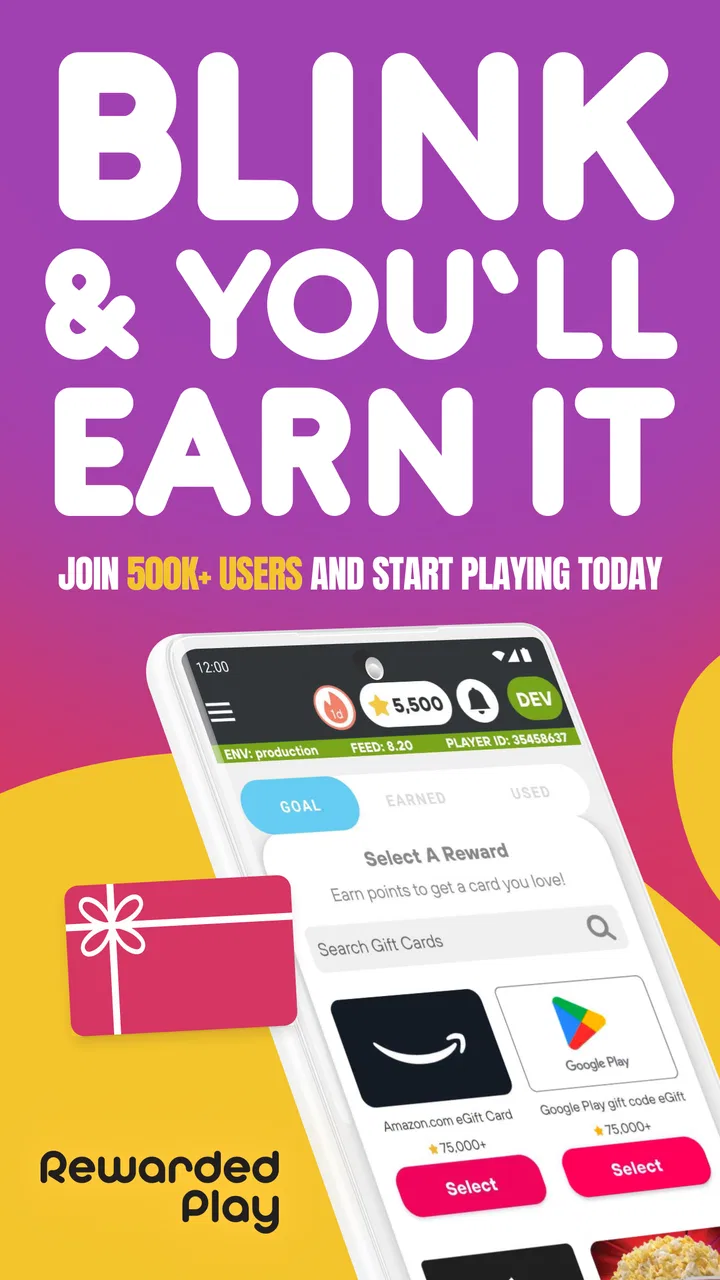
Rewarded Play: Play and Earn
- 4.2
- Rating
- 10.00M
- Installs
- Free
- Price

 Analysis by App-foxy
I approached Rewarded Play: Earn Gift Cards as a practical lifestyle app rather than as a serious gaming platform. The basic idea is easy to understand: I play selected mobile games, make progress, and work toward gift-card rewards. That makes it most interesting for people who already enjoy casual games and would like their spare-time activity to lead somewhere tangible.
My first impression is that the app sits between a game discovery tool and a rewards service. It is free, aimed at Everyone, and developed by Influence Mobile, Inc. Its store summary focuses on earning gift cards from retailers such as Amazon and Walmart, with a quick redemption promise. I would not treat that wording as a guarantee that every reward arrives instantly in every situation, but it does explain the appeal: the app tries to turn short gaming sessions into a small, trackable benefit.
From spare minutes to a possible gift card
I find the best way to judge Rewarded Play is to separate the time spent playing from the reward I might eventually receive. In this section, I’ll look at what a sensible first session can tell me about that balance, including whether the game suits a short break or demands more attention than I want to give. That perspective leads naturally to the practical question of how to choose a starting point.
You May Also Like

 Blood Strike: 2.5 Anniversary
Blood Strike’s Loadouts Turn Every Drop Into a Tactical Gamble
A close look at Blood Strike’s custom loadouts: how fast access to signature weapons reshapes its battle royale rhythm, rewards preparation, and narrows the gap between fights.

 Pandora - Music & Podcasts
Pandora’s Music Is Easy to Start, but Harder to Recover
Pandora’s strength is its low-effort path from a seed to a station. Its weak spot is how much confidence it asks you to place in connection, setup, and quiet recovery.

 8 Ball Pool
 Is Built on Rivalries, Rematches, and Routine
A close look at the rivalries, rematches, shared routines, and unanswered safety questions that turn a quick pool match into a persistent mobile community.

 Samsung Music
’s Quiet Strength Is Playing What You Already Own
Its reach comes less from spectacle than from dependable access to a personal library. That simplicity is both the app’s strongest retention engine and its ceiling.

 AccuWeather: Weather Radar
AccuWeather Review: A Quick, Clear Forecast for Everyday Decisions
For everyday plans, the best forecast is the one you can understand quickly. AccuWeather makes rain timing, radar, and local conditions easy to act on, with a few trade-offs.

 Hill Climb Racing
Why Hill Climb Racing Still Turns Crashes Into One More Run
A tiny car, a bumpy hill and one more upgrade: Hill Climb Racing keeps resurfacing because its simple chaos makes every near-miss feel personal.
More From Our News Desk
View All News


Who will get the most from the starting point
The best starting condition is simple: I have an Android phone, some patience, and a willingness to play games I might not otherwise choose. This is not the right tool if I want a direct cash-earning job, predictable hourly income, or complete control over the games I use. The rewards concept works better as a bonus attached to entertainment than as a dependable source of money.
That distinction matters before installing it. A person who already spends a few minutes with casual games may find the arrangement enjoyable. Someone who dislikes trying unfamiliar titles, tracking progress, or waiting for a reward will probably feel that the exchange is not worthwhile. I would also skip it if my only goal is to receive a specific retailer card immediately, because the practical experience depends on completing the app’s required activity and moving through the redemption process.
The app has built a substantial audience, with over ten million installs and an average rating of 4.2 from around 244 thousand ratings. Those figures suggest that the concept is easy for many people to understand, but popularity does not remove the need to read each task carefully. A large user base can tell me that the service is widely used; it cannot tell me whether every individual game or reward target will suit my habits.
Choosing a game without wasting the first session
I would begin by looking at the available games as a list of possible routes rather than tapping the first option immediately. The important question is not simply “Does this look fun?” It is “Can I see myself returning to this game long enough to reach the relevant progress point?” A game that feels entertaining for ten minutes but becomes repetitive afterward may be a poor choice even if its reward looks attractive.
This is one of the less obvious trade-offs in the app. The reward can influence my game choice, but the game itself determines whether the journey feels like leisure or a chore. I would favor a title with controls and pacing that feel comfortable on my phone. If a game requires constant attention while I am commuting, waiting for an appointment, or taking a short break, it may not fit my routine even when the gift card goal seems appealing.
I would also avoid installing several options at once. Starting with one game makes it easier to understand how progress is recognized and prevents my attention from being divided. It gives me a cleaner answer to a practical question: am I actually enjoying the activity, or am I only continuing because I have already invested time?
The step-by-step flow in everyday use
In a realistic scenario, I might have a quiet evening and want something more purposeful than scrolling through social media. I open Rewarded Play, review the available game choices, and select one that matches the kind of casual play I already enjoy. From there, I move into the game and focus on its normal objectives while keeping the reward goal in mind.
The first useful habit is to check what counts as progress before assuming that simply opening a game is enough. Reward systems often depend on a defined action, milestone, or period of activity. I would read the wording shown in the app, note the target in my head, and avoid relying on memory if the task has several stages. This small pause can prevent the most frustrating mistake: spending time playing without knowing whether the activity is moving me toward the intended outcome.
After playing, I would return to the rewards area and look for the updated status. The app’s value depends on that handoff between the game and the tracking system. If the progress appears, I know the route is functioning. If it does not, I would not immediately repeat a long session. I would first check whether I completed the correct objective, whether the app has had time to update, and whether I started the game through the expected path.
That workflow is more important than the cheerful promise of gift cards. The real experience is a chain: choose an activity, complete the relevant action, allow the progress to register, and then move toward redemption. Any weak link can make the result feel disappointing, especially when the user assumes that all play automatically qualifies.
What happens when the game hands work back to the app
The handoff between a selected game and Rewarded Play is where I would pay the closest attention. The game is the place where I spend time, but the rewards app is the place where that time must become recognizable progress. I would therefore keep the app updated and avoid changing my routine unnecessarily while testing the first game.
If the tracking feels delayed, I would give it a reasonable moment and then inspect the task details rather than continuing indefinitely. This is a useful rule for protecting my time: never treat unconfirmed progress as proof that a reward is already secured. I would rather pause and understand the status than play for another hour based on an assumption.
Another practical point is consistency. If I switch between devices, reinstall a game, or move in and out of the reward app without checking the current task, I make it harder to understand what happened if the progress does not appear. I would keep the process simple during the first attempt: one device, one selected game, and one clearly understood target.
This is also where the app differs from ordinary alternatives. A standard game launcher helps me find and open games, but it does not give the activity a reward-oriented destination. A survey app, on the other hand, asks me to provide opinions directly, which can be more predictable for users who prefer short questionnaires over gameplay. Rewarded Play is better suited to someone who would rather earn through an activity they already find entertaining, even though the path may take longer and involve more tracking.
Moving from progress to redemption
Once I reach the relevant reward threshold, the next handoff is from accumulated progress to a gift-card request. This is the moment when I would slow down again and check the selected retailer, the reward value, and any details the app asks me to review. A rushed tap at this stage can create confusion if I expected one type of card and selected another.
The app promotes gift cards connected with well-known shopping destinations, including Amazon and Walmart. That makes the result more useful for everyday spending than an abstract points balance. I can imagine applying a card toward household items, a small digital purchase, or a planned order. Still, I would think of the reward as a modest reduction in a future expense, not as a replacement for income.
The advertised delivery window is framed around 48 hours, which is attractive for a rewards service. I would plan around that window rather than around an immediate arrival. If I needed the credit for a purchase happening within the next few minutes, I would use a payment method I already had available. The sensible approach is to submit the redemption with enough time before the intended purchase and keep the confirmation details until the card arrives.
This is one of the app’s strongest practical ideas: the outcome is concrete enough to motivate continued use. It is also one of its biggest psychological risks. When a reward is close, I may feel tempted to keep playing solely because I have already invested time. I would set a personal limit and ask whether I am still enjoying the game. If the answer is no, the remaining effort may not feel worthwhile.
The result: useful bonus, not reliable earnings
When the process works smoothly, the result is satisfying because the reward connects directly to something I did for fun. I finish a session, see progress accumulate, and eventually receive a gift card that can be used in ordinary shopping. That is a clearer outcome than collecting points with no obvious purpose.
However, the value depends on how I measure my time. If I would have played the game anyway, the reward feels like a pleasant extra. If I would never have chosen the game without the incentive, I need to judge the experience more critically. The reward may still be worthwhile, but only if the time, attention, storage space, and repetition feel acceptable to me.
I would describe the app as a good fit for casual players who like measurable goals. It can add structure to otherwise idle moments, and the reward destination gives those sessions a reason to continue. It is less suitable for people seeking guaranteed earnings, fast cash, or a completely passive system. Nothing about the concept removes the need to play, monitor progress, and complete the redemption step.
Where the flow breaks down
The first likely friction point is unclear progress. If I do not know which action qualifies, I can easily confuse ordinary game advancement with reward advancement. My solution would be to read the task instructions before playing, take note of the intended milestone, and check the status after a short test session instead of committing a large block of time immediately.
The second is motivation. Some games are enjoyable at the beginning but become repetitive once the novelty disappears. Rewarded Play cannot make an unsuitable game entertaining forever. I would treat the first session as a trial and stop if the experience feels like forced labor. A different rewards category, such as surveys or cashback, may suit me better if I prefer predictable, non-game tasks.
The third issue is redemption timing. Even with a quick delivery promise, I would not build an urgent purchase around an unreceived card. I would also keep my expectations realistic about the size of the benefit. A free app can make a small reward feel meaningful, but it is not a shortcut to substantial financial returns.
There is also a privacy and attention trade-off I would consider before making it part of my routine. Any app that connects game activity with rewards deserves a careful look at its permissions and account behavior during setup. I would only provide information that feels necessary for the service and would remove the app if the overall exchange no longer seemed worthwhile. The convenience of a gift card should not make me ignore how much attention the workflow demands.
How I would use it without letting it take over
My preferred method would be to choose one game, set a short personal play window, and review progress before extending that window. This keeps the reward from becoming an open-ended commitment. If the game is genuinely fun, I can continue. If it is not, I have limited the amount of time spent chasing an uncertain benefit.
I would also redeem as soon as a suitable reward becomes available rather than accumulating an unnecessarily large balance. A completed redemption gives me a clear result and reduces the temptation to keep playing simply because the next target is visible. For household budgeting, I would record the card as a small discount on a planned purchase, not as money I can depend on each month.
For families, the Everyone rating makes the app broadly approachable, but I would still explain the difference between playing for entertainment and playing for rewards. Younger users may focus on the promise of a gift card and overlook the time involved. A parent can make the experience healthier by setting boundaries around screen time and by treating the reward as an occasional bonus rather than a required goal.
Device and version considerations
The current version is 13.6.1, and the app supports Android 9 or later. That makes checking the phone’s operating system a sensible first step before expecting a smooth installation. I would also keep enough storage available for the games themselves, because the reward app is only one part of the full workflow.
Since the service depends on movement between the rewards app and separate games, I would update both sides when updates are available through the normal store process. I would not assume that a problem in one game reflects the entire service. Testing another listed game can help distinguish a title-specific issue from a broader tracking problem, although I would avoid repeatedly installing games just to chase a better-looking target.
Compared with a normal casual-game collection, the extra reward layer is the main reason to choose this app. Compared with a dedicated cashback service, it asks for more active participation. Compared with survey platforms, it may feel more enjoyable but less predictable in terms of how long a task takes. That positioning is clear enough: it is for people who want entertainment first and a modest benefit second.
My recommendation after following the complete route
I would recommend Rewarded Play: Earn Gift Cards to a friend who already likes mobile games and wants to make idle play feel a little more purposeful. The free entry point, broad age rating, recognizable gift-card destinations, and large user community make it easy to try. The developer, Influence Mobile, Inc., has built an app that is straightforward in concept and appealing when the tracking and redemption steps connect cleanly.
I would not recommend it to someone who needs dependable income, dislikes promotional reward systems, or has no patience for checking whether progress has registered. In those cases, a conventional game may be more relaxing, while a survey or cashback app may offer a better match for the person’s preferred way of earning small benefits.
My final view is positive but measured. The app can turn casual gaming into a useful little outcome, yet the reward should remain secondary to whether the activity is worth my time. If I choose games carefully, verify progress early, protect my play limits, and plan around the redemption window, the workflow feels reasonable. Use it as a bonus for play you would enjoy anyway, not as a promise of easy income.
FAQs for Rewarded Play: Play and Earn
01What is Rewarded Play and how does it work?
Rewarded Play is an app that allows users to earn gift cards by playing games on their mobile devices. Users select from a variety of popular games and accumulate points based on their in-app activity. These points can then be redeemed for gift cards to major retailers like Amazon or Walmart. It’s a great way to enjoy gaming while earning rewards.
02Is Rewarded Play free to use?
Yes, Rewarded Play is completely free to download and use. There are no hidden fees or subscriptions required. Users can start earning points by playing games without any upfront costs. However, be aware that some games may offer in-app purchases, which are optional and not necessary for earning points.
03How do I redeem points for gift cards in Rewarded Play?
Redeeming points in Rewarded Play is straightforward. Once you accumulate enough points from playing games, you can navigate to the rewards section within the app. There, you can choose from a selection of available gift cards and redeem your points for your preferred reward. The app will guide you through the redemption process step by step.
04Are there any geographic restrictions for using Rewarded Play?
Rewarded Play may have geographic restrictions, meaning it might not be available in all countries. Before downloading, check the app’s listing on the Google Play Store or Apple App Store to see if it’s available in your region. Additionally, some gift card options might be limited based on your location.
05What types of games are available on Rewarded Play?
Rewarded Play offers a wide variety of games, ranging from puzzle and trivia games to strategy and casual titles. The app frequently updates its game library, ensuring users have access to new and popular games. This variety ensures that there’s something for everyone, regardless of gaming preferences.
Pros
- Easy to use interface for quick navigation.
- Wide variety of games to choose from.
- Reliable gift card redemption process.
- Frequent updates with new features.
- Allows earning rewards while having fun.
Cons
- Requires stable internet connection.
- Limited to specific regions.
- Can consume significant battery life.
- Some games need additional downloads.
- Earning points can be time-consuming.

Rewarded Play: Play and Earn
Gallery